Bilingual Digital Architecture for Islamic Institutions: Engineering Arabic-English Platforms at Enterprise Scale
A prominent London scholar with 500,000 Instagram followers recently launched a new website. Within hours, Arabic-speaking followers flooded the comments: "The Arabic version is broken," "WhatsApp sharing shows gibberish," "I can't read the Arabic text on mobile."
The developer had "added Arabic support" by running English content through Google Translate and adding it to the site. The result? A website that looked professional in English but was unusable, ugly, and unprofessional in Arabic—alienating half the potential audience.
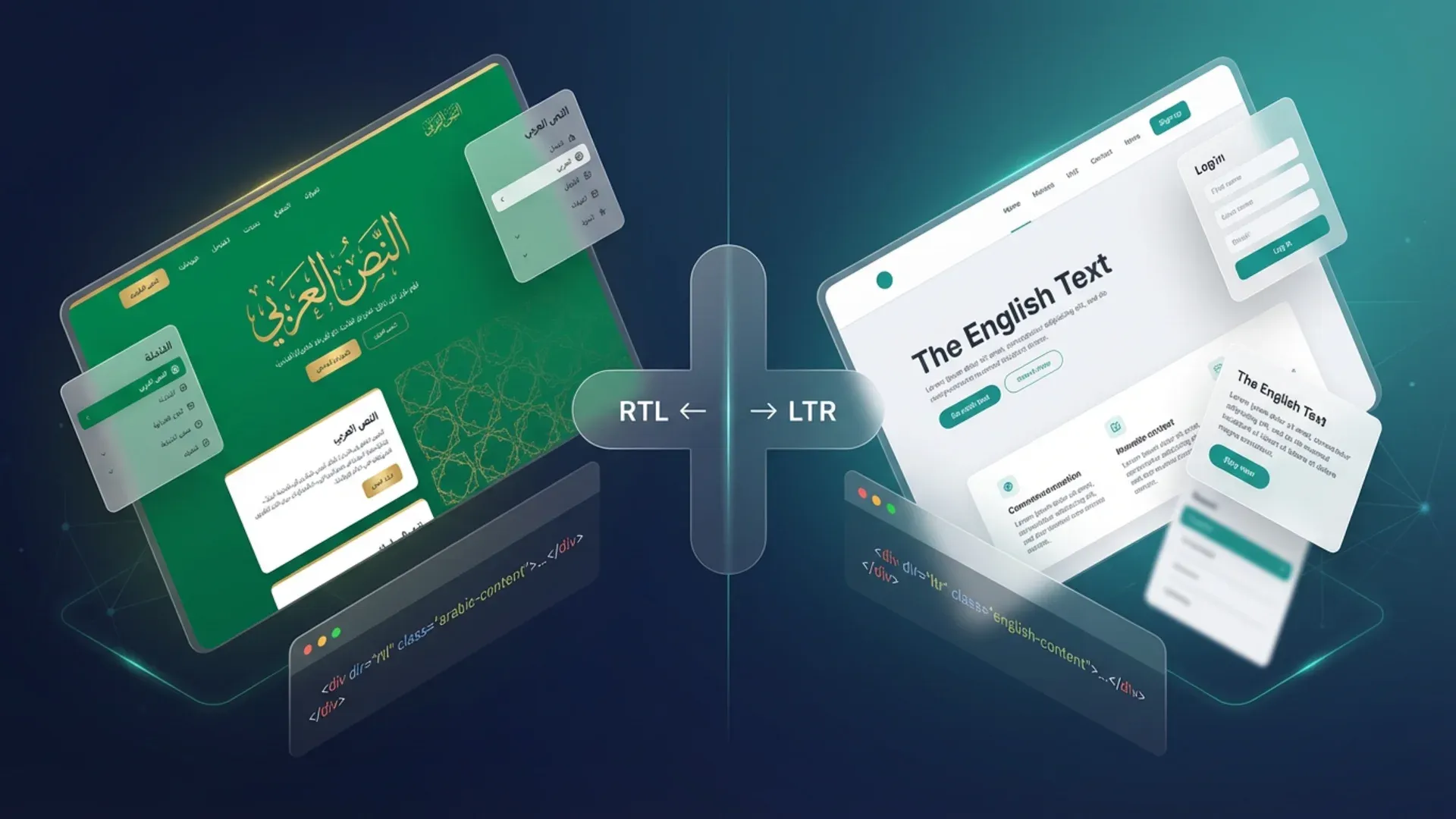
This article explores the technical architecture required to build truly bilingual platforms that serve both UK and Gulf communities with excellence, going far beyond translation to proper right-to-left engineering, beautiful typography systems, and culturally-aware design.
The Billion-User Opportunity: Why Arabic Matters for Islamic Institutions
Market size that demands technical excellence:
Arabic-speaking Muslims worldwide: 400+ million
UK Muslims who speak Arabic: 500,000+ (est)
Gulf region Muslims: 60+ million
North American Arabic speakers: 1.5+ million
Digital language preferences in Muslim communities:
Primary English users: 40%
Primary Arabic users: 35%
Bilingual (switch based on content): 25%
What this means: A website that's excellent in English but broken in Arabic is excluding 35-60% of potential audience, depending on the institution's community composition.
For Islamic institutions serving Gulf markets: Arabic isn't just "also important," it's often the primary language for donors, community members, and leadership.
Beyond Translation: What "Bilingual Architecture" Actually Means
Most developers think bilingual support means:
1. Translate English text to Arabic ✅
2. Add language switcher ✅
3. Done ✅
This is catastrophically insufficient. True bilingual architecture requires:
1. Right-to-Left (RTL) Layout Engineering
Not just flipping content direction
But re-architecting entire visual hierarchy for RTL reading patterns
2. Typography System Design
Not just using any Arabic font
But engineering font stacks that work across browsers, devices, and screen sizes
3. Content Management Architecture
Not just two versions of each page
But unified content structure with locale-aware rendering
4. Performance Optimization
Not just adding Arabic fonts (which adds 500KB-2MB to page weight)
But subsetting, optimizing, and strategically loading typography assets
5. Cultural Design Considerations
Not just mirroring English layouts
But adapting visual design for Arabic aesthetic preferences
6. Technical SEO for Arabic
Not just translating meta tags
But proper hreflang implementation, Arabic schema markup, and localized search optimization
Let's break down each architectural layer.
Architecture Layer #1: Right-to-Left (RTL) Layout Engineering
RTL isn't just about changing direction: rtl in CSS. It's about rethinking entire visual hierarchy.
Common mistakes that break Arabic layouts:
Mistake #1: Naive CSS direction flip
/* WRONG: Flips everything, including things that shouldn't flip */
html[lang="ar"] {
  direction: rtl;
}
/* Result: Logos flip backwards, icons misalign, layouts break */
Correct approach: Logical properties with selective RTL
/* Use logical properties that respect writing direction */
.container {
  margin-inline-start: 2rem; /* Auto-adjusts for RTL/LTR */
  padding-inline-end: 1rem;   /* Auto-adjusts for RTL/LTR */
  border-inline-start: 1px solid;
}

/* Keep specific elements LTR even in RTL context */
.logo, .icons, .numbers {
  direction: ltr; /* Don't flip logos or icons */
}
Mistake #2: Hard-coded positioning
/* WRONG: Position assumes LTR */
.sidebar {
  position: absolute;
  left: 0; /* Breaks in RTL, sidebar appears on wrong side */
}
Correct approach: Logical positioning
.sidebar {
  position: absolute;
  inset-inline-start: 0; /* Auto-adjusts for RTL/LTR */
}
Mistake #3: Flex/Grid without direction awareness
/* WRONG: Flex direction breaks in RTL */
.navigation {
  display: flex;
  justify-content: flex-start; /* Always aligns left, even in RTL */
}
Correct approach: Direction-aware Flexbox
.navigation {
  display: flex;
  justify-content: start; /* Logical start (adjusts for RTL/LTR) */
}
Real-world example: Donation form layout
English (LTR):
[Amount] [Currency ▼] [Donate →]Arabic (RTL) - Wrong implementation:
[→ تبرع] [▼ العملة] [المبلغ] (Buttons mirrored but feel wrong)Arabic (RTL) - Correct implementation:
[المبلغ] [▼ العملة] [تبرع ←] (Natural RTL flow, arrow points left)CSS implementation:
.donation-form {
  display: flex;
  gap: 1rem;
}

/* Amount input */
.amount-input {
  flex: 1;
  text-align: start; /* Auto-adjusts: right in RTL, left in LTR */
}

/* Submit button */
.submit-button {
  /* Icon positioning based on reading direction */
}

html[lang="en"] .submit-button::after {
  content: "→";
  margin-inline-start: 0.5rem;
}

html[lang="ar"] .submit-button::after {
  content: "←";
  margin-inline-start: 0.5rem;
}
Architecture Layer #2: Typography System Engineering
Arabic typography is one of the hardest problems in bilingual architecture. Most developers use system defaults, resulting in ugly, unreadable Arabic text.
The problem with default Arabic fonts:
Windows default (Arial):
- Designed for Latin scripts, Arabic is an afterthought
- Letter connections break or look disconnected
- Vertical spacing is wrong (too much gap between lines)
- Diacritics (Harakat) overlap with text
- Result: Looks unprofessional, hard to read
macOS/iOS default (SF Arabic):
- Better than Arial but still not designed for extended reading
- Too geometric, lacks traditional Arabic calligraphic flow
- Works for UI, fails for body text
Professional Arabic typography system:
1. Font stack strategy:
/* Carefully engineered font stack for Arabic */
body[lang="ar"] {
  font-family:
    'Noto Naskh Arabic', /* Google Fonts, beautiful Naskh style */
    'Amiri',              /* Traditional, excellent for scholarly content */
    'Cairo',              /* Modern, works well for UI */
    'Tajawal',            /* Clean, good for body text */
    'Arial',              /* Fallback (better than nothing) */
    sans-serif;
}

/* Different stack for headings (more decorative) */
h1[lang="ar"], h2[lang="ar"], h3[lang="ar"] {
  font-family:
    'Amiri',              /* Traditional elegance for titles */
    'Lateef',             /* Alternative traditional style */
    'Noto Naskh Arabic',
    serif;
}
2. Font subsetting for performance:
Arabic fonts are massive (500KB-2MB) because they include:
- Arabic characters (ا-ي)
- Arabic digits (٠-٩)
- Latin characters (fallback)
- Extended Arabic (Urdu, Persian, etc.)
- Diacritics (Harakat: َ ِ ُ ً ٍ ٌ ْ ّ)
Problem: Loading full font kills performance
Full Amiri font: 1.8MB download
Page load time: +4 seconds on 3G mobile
Bounce rate: 40% of users leave before content loads
Solution: Subset fonts to only needed characters
/* Only load Arabic subset (reduce to 200KB) */
@font-face {
  font-family: 'Amiri';
  src: url('/fonts/amiri-arabic-only.woff2') format('woff2');
  unicode-range: U+0600-06FF, U+0750-077F, U+08A0-08FF, U+FB50-FDFF, U+FE70-FEFF;
  font-display: swap; /* Show fallback immediately, swap when loaded */
}
3. Line height and spacing adjustments:
Arabic requires different vertical spacing than English due to:
- Ascending/descending letter forms (ك vs ب)
- Diacritics above and below letters
- Connected letter forms
English optimal line-height: 1.5 Arabic optimal line-height: 1.8-2.0 (needs more space)
body[lang="en"] {
  line-height: 1.6;
  letter-spacing: 0.01em;
}

body[lang="ar"] {
  line-height: 1.9; /* More vertical space for diacritics */
  letter-spacing: 0; /* Arabic doesn't use letter-spacing */
  word-spacing: 0.1em; /* But benefits from word-spacing */
}
Architecture Layer #3: Content Management System Design
Managing bilingual content is more complex than "create English page, create Arabic page."
Naive approach (doesn't scale):
/about-us.html (English)
/ar/about-us.html (Arabic copy-paste)

Problems:
- Content sync nightmare (update English, forget Arabic)
- URL structure inconsistent
- No fallback if translation missing
- Impossible to maintain at scale
Professional approach: Unified content structure
Option 1: File-based CMS with locale folders (Astro/Keystatic approach)
src/content/
  pages/
    en/
      about.mdoc (English content)
      services.mdoc
    ar/
      about.mdoc (Arabic content)
      services.mdoc

config:
  defaultLocale: 'en'
  fallback: true (show English if Arabic missing)
Option 2: Headless CMS with localization (Sanity/Contentful)
// Content structure in Sanity
{
  _type: 'page',
  title: {
    en: 'About Us',
    ar: 'من نحن'
  },
  content: {
    en: [...English blocks...],
    ar: [...Arabic blocks...]
  },
  seo: {
    en: { title: '...', description: '...' },
    ar: { title: '...', description: '...' }
  }
}
Benefits of unified structure:
- One update propagates to all locales
- Missing translation handling (fallback to English)
- Synchronized publish/unpublish
- Audit trail (know what needs translation)
Routing architecture:
English (default, no prefix):
https://mosque.com/about
https://mosque.com/services
https://mosque.com/contact
Arabic (with /ar prefix):
https://mosque.com/ar/about (or /ar/من-نحن for localized slugs)
https://mosque.com/ar/services
https://mosque.com/ar/contact
Implementation (Astro example):
// astro.config.ts
export default defineConfig({
  i18n: {
    defaultLocale: 'en',
    locales: ['en', 'ar'],
    prefixDefaultLocale: false, // /about not /en/about
    routing: {
      strategy: 'pathname' // Locale in URL path
    }
  }
})
Architecture Layer #4: Cultural Design Considerations
Arabic design aesthetics differ from English in subtle but important ways:
Color psychology varies:
English audiences: Blue = trust, professional
Arabic audiences: Green = Islamic, trustworthy, preferred
Visual density preferences:
English design: Minimalism, white space, sparse
Arabic design: Richer colors, decorative patterns, denser layouts
Navigation patterns:
English: Horizontal top navigation
Arabic: Often prefer more prominent menu (top + sidebar)
Call-to-action button styling:
English: Subtle, small, minimalist buttons
Arabic: Larger, more prominent, decorative buttons
Real-world example: Mosque donation page
English version design:
- Clean white background
- Small "Donate" button (top-right)
- Minimalist layout with lots of white space
- Sans-serif typography throughout
Arabic version (naive translation):
- Same clean white background (feels empty in Arabic aesthetic)
- Small "تبرع" button (feels less important)
- Too much white space (feels unfinished)
- Same typography (lacks Arabic elegance)
Arabic version (culturally-adapted):
- Warmer background color (beige/cream, more traditional)
- Larger "تبرع" button with decorative border (culturally appropriate)
- Balanced white space (not sparse, not crowded)
- Elegant Arabic typography with traditional touches
- Optional: Subtle Islamic geometric patterns in background
CSS implementation:
/* Shared base styles */
.donation-section {
  padding: 4rem 2rem;
}

/* English-specific styling */
html[lang="en"] .donation-section {
  background: #ffffff;
  background-image: none;
}

html[lang="en"] .donate-button {
  font-size: 1rem;
  padding: 0.75rem 1.5rem;
  border: 1px solid;
  font-weight: 500;
}

/* Arabic-specific styling */
html[lang="ar"] .donation-section {
  background: #f9f7f4; /* Warmer tone */
  background-image: url('/patterns/islamic-pattern-subtle.svg');
  background-size: 400px;
  background-repeat: repeat;
  opacity: 0.03;
}

html[lang="ar"] .donate-button {
  font-size: 1.25rem; /* Larger */
  padding: 1rem 2.5rem;
  border: 2px solid; /* Thicker border */
  font-weight: 700;
  background: linear-gradient(135deg, #00a650 0%, #008f44 100%); /* Green gradient */
}
Architecture Layer #5: Technical SEO for Arabic Content
Google and other search engines need explicit signals that Arabic content exists and how it relates to English content.
1. Hreflang implementation:
Tells search engines: "This English page has an Arabic equivalent"
<!-- On English page (https://mosque.com/about) -->
<link rel="alternate" hreflang="en" href="https://mosque.com/about" />
<link rel="alternate" hreflang="ar" href="https://mosque.com/ar/about" />
<link rel="alternate" hreflang="x-default" href="https://mosque.com/about" />

<!-- On Arabic page (https://mosque.com/ar/about) -->
<link rel="alternate" hreflang="en" href="https://mosque.com/about" />
<link rel="alternate" hreflang="ar" href="https://mosque.com/ar/about" />
<link rel="alternate" hreflang="x-default" href="https://mosque.com/about" />
Benefits:
- Google shows Arabic page to Arabic searchers
- Prevents duplicate content penalties
- Improves search rankings in Gulf region
2. Schema markup for Arabic:
{
  "@context": "https://schema.org",
  "@type": "Mosque",
  "name": "Central London Mosque",
  "alternateName": "المسجد المركزي في لندن",
  "description": "A mosque serving the London Muslim community",
  "inLanguage": ["en", "ar"],
  "address": {
    "@type": "PostalAddress",
    "streetAddress": "123 High Street",
    "addressLocality": "London",
    "addressCountry": "GB"
  },
  "prayerTimes": {
    "Fajr": "05:30",
    "Dhuhr": "13:15",
    "Asr": "15:45",
    "Maghrib": "18:20",
    "Isha": "19:50"
  }
}
3. Arabic sitemap:
<?xml version="1.0" encoding="UTF-8"?>
<urlset xmlns="http://www.sitemaps.org/schemas/sitemap/0.9"
        xmlns:xhtml="http://www.w3.org/1999/xhtml">
  <url>
    <loc>https://mosque.com/about</loc>
    <xhtml:link rel="alternate" hreflang="ar" href="https://mosque.com/ar/about" />
    <xhtml:link rel="alternate" hreflang="en" href="https://mosque.com/about" />
  </url>
  <url>
    <loc>https://mosque.com/ar/about</loc>
    <xhtml:link rel="alternate" hreflang="ar" href="https://mosque.com/ar/about" />
    <xhtml:link rel="alternate" hreflang="en" href="https://mosque.com/about" />
  </url>
</urlset>
Architecture Layer #6: Social Sharing and WhatsApp Integration
Arabic-speaking communities heavily use WhatsApp for sharing content. If your Arabic content breaks when shared, you lose massive organic reach.
Problem: Garbled Arabic text in WhatsApp previews
Cause: Missing UTF-8 encoding or incorrect meta tags
Result: "Ù…Øمد صلى الله عليه وسلم" instead of "محمد صلى الله عليه وسلم"Solution: Proper Open Graph meta tags for Arabic
<!-- Arabic page meta tags -->
<meta charset="UTF-8" /> <!-- Critical -->
<meta property="og:locale" content="ar_SA" />
<meta property="og:locale:alternate" content="en_GB" />
<meta property="og:title" content="من نحن - المسجد المركزي" />
<meta property="og:description" content="نخدم المجتمع المسلم في لندن منذ 1985" />
<meta property="og:image" content="https://mosque.com/og-images/about-ar.jpg" />
<meta property="og:url" content="https://mosque.com/ar/about" />

<!-- Twitter cards for Arabic -->
<meta name="twitter:card" content="summary_large_image" />
<meta name="twitter:title" content="من نحن - المسجد المركزي" />
<meta name="twitter:description" content="نخدم المجتمع المسلم في لندن منذ 1985" />
Testing checklist:
- [ ] Share Arabic page on WhatsApp (UK and Gulf numbers)
- [ ] Check preview shows Arabic correctly
- [ ] Share on Facebook, verify Arabic displays properly
- [ ] Share on Twitter/X, verify Arabic doesn't break
- [ ] Test from iOS and Android devices
Real-World Architecture: Full-Stack Bilingual Platform
For a major Islamic institution serving UK and Gulf markets, here's the complete technical stack:
Frontend Framework: Astro (Static Site Generation)
Why: Excellent i18n support, blazing fast performance
RTL support: Built-in with Astro i18n
Bundle size: Minimal (ships zero JS for static pages)
Content Management: Keystatic (File-based CMS)
Why: Editor-friendly, version controlled, locale folders
Content structure: /en and /ar folders for clear separation
Translation workflow: Side-by-side editing, easy to see what's missing
Hosting: Cloudflare Pages
Why: Global CDN, instant propagation to Gulf region
Performance: <50ms response time in London and Dubai
Cost: Free tier covers most mosques
Typography: Subset Google Fonts
English: Inter (clean, professional)
Arabic: Amiri (traditional, beautiful) + Cairo (modern UI)
Optimization: Subset to 200KB per language (from 2MB original)
Database: Supabase PostgreSQL
Why: JSON support for multilingual content, realtime subscriptions
Localization: Store bilingual content in JSONB columns
Queries: Easy to filter by locale
Performance metrics (real implementation):
English page load: 1.2 seconds (3G mobile)
Arabic page load: 1.4 seconds (3G mobile, includes Arabic fonts)
Lighthouse score English: 98/100
Lighthouse score Arabic: 96/100
Cost breakdown:
Hosting (Cloudflare Pages): £0/month (free tier)
CMS (Keystatic): £0/month (self-hosted)
Database (Supabase): £0-25/month (free tier or pro)
Fonts (Google Fonts): £0/month (free)
Total monthly: £0-25/month for institutional-grade bilingual platform
Checklist: Is Your Bilingual Architecture Enterprise-Ready?
RTL Layout Engineering:
- [ ] All layouts work correctly in both LTR and RTL
- [ ] Logos and icons don't flip in RTL
- [ ] Forms and inputs display correctly in Arabic
- [ ] Navigation feels natural in RTL (not just mirrored)
- [ ] Tested on Safari, Chrome, Firefox in RTL mode
Typography System:
- [ ] Beautiful, readable Arabic font (not Arial/default)
- [ ] Fonts subset to reduce file size (<300KB)
- [ ] Line-height optimized for Arabic (1.8-2.0)
- [ ] Diacritics don't overlap with text
- [ ] Font loads don't block page render (font-display: swap)
Content Management:
- [ ] Unified content structure (not duplicate pages)
- [ ] Fallback to English if Arabic translation missing
- [ ] Easy to see what content needs translation
- [ ] URL structure consistent (/ar/page not /ar/page.html)
Cultural Design:
- [ ] Color palette adapted for Arabic audience
- [ ] Visual density appropriate for locale
- [ ] CTAs sized appropriately (larger in Arabic)
- [ ] Decorative elements culturally appropriate
Technical SEO:
- [ ] Hreflang tags on every page
- [ ] Arabic sitemap generated
- [ ] Schema markup includes Arabic alternateNames
- [ ] Meta tags properly encoded (UTF-8)
Social Sharing:
- [ ] WhatsApp preview shows Arabic correctly
- [ ] Facebook sharing displays Arabic properly
- [ ] Twitter/X cards work with Arabic text
- [ ] Tested from both iOS and Android devices
Conclusion: Bilingual as Competitive Advantage
In a digital landscape where most developers treat Arabic as an afterthought, institutional-quality bilingual architecture is a massive competitive advantage.
For mosques: Serve both English-speaking and Arabic-speaking communities with excellence.
For scholars: Reach global audiences in their preferred language.
For Islamic organizations: Expand to Gulf markets without rebuilding infrastructure.
True bilingual architecture isn't about translation. It's about engineering platforms that honor both languages with equal excellence, respecting the technical requirements of RTL layout, the aesthetic beauty of Arabic typography, and the cultural preferences of diverse Muslim communities.
When done correctly, bilingual architecture doesn't double development time. It multiplies institutional reach by 10x.
May Allah grant us the Tawfiq to serve His Ummah with technical excellence that transcends language barriers.
Building a bilingual platform for your Islamic institution? Schedule a consultation to discuss your Arabic-English architecture requirements.